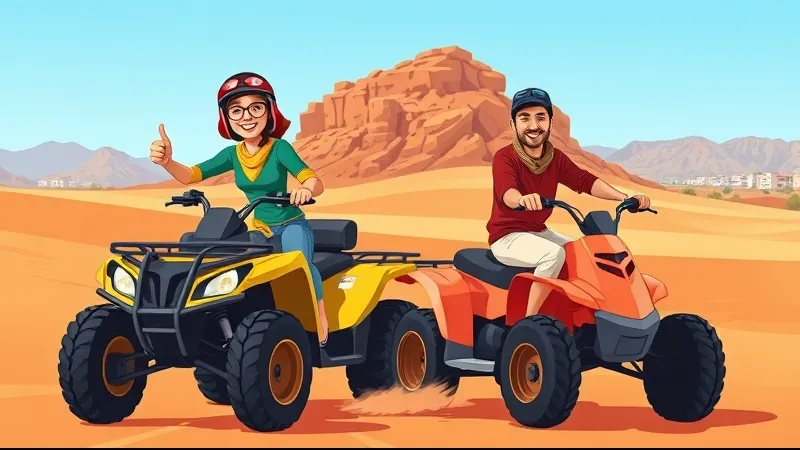
Is a quad tour in Marrakech safe, and what should operators provide?
A quad tour near Marrakech is reasonably safe when a serious operator handles it, and genuinely risky when it is booked from an unlicensed roadside stall. Quad biking is a motorised off-road activity, so the risk is real, but it is manageable when a few basics are present. A reputable Agafay or Palmeraie operator provides a certified helmet in your size, a pre-ride safety briefing, a short hands-on training lap, third-party liability insurance, and a guide who stays with a small group throughout the ride. Moroccan law requires a helmet for both driver and passenger, and no driving licence is needed for guided tours on private tracks.
The single most useful thing you can do is ask, in writing, three questions before you pay: what helmet standard is provided, what insurance is included, and what training you get before setting off. A serious operator answers clearly; a vague or evasive reply is itself an answer. Beginners are fine on the flat Palmeraie tracks or the open Agafay plateau — the technical, rockier Jbilat hills are less forgiving. If you want a quick side-by-side of the terrain and formats, see our Agafay vs Palmeraie comparison.
What safety equipment should a serious quad operator provide?
A serious operator provides a certified helmet in the correct size as the non-negotiable minimum. Look for a helmet marked to the ECE 22.06 European standard or a DOT-certified equivalent. Operators typically also provide goggles or a visor — useful against dust on the Agafay tracks — and usually gloves. You are normally expected to bring closed shoes yourself.
Most quad tours hand out an open-face helmet, which protects the skull and top of the head but leaves the face exposed; a full-face helmet adds a chin bar and better dust protection but is less common on tourist rides. Either way, a helmet is legally the minimum for any engine-powered vehicle in Morocco, and it applies to passengers on double quads too, not just the driver.
Before you ride, check the helmet condition yourself. The strap should click shut and hold firm, the shell should have no visible cracks, and the padding should fit snugly without wobbling. A helmet that slides around or won't fasten properly is not doing its job. The U.S. Consumer Product Safety Commission's ATV guidance is blunt on this point: a helmet plus eye protection, gloves, long trousers and boots is the baseline for any all-terrain vehicle.
How does insurance work on a Marrakech quad tour?
Insurance on a quad tour comes in layers, and it is worth understanding which one covers what. The first layer is the operator's third-party liability insurance, which covers damage or injury the activity causes to other people. The second is optional personal accident cover, which some operators offer for your own injuries. The third is your own travel insurance, which sits over everything.
Here is the trap most riders miss: many standard travel policies exclude motorised off-road activities unless you buy an "adventure sports" add-on. A quad or ATV usually falls into that excluded category by default. The UK FCDO travel advice for Morocco makes the general point plainly — buy insurance that actually covers your planned activities, and read what it excludes. Check your policy wording for "motorised" or "off-road" exclusions before you assume you are covered.
Coverage offered by operators varies widely, so do not assume it is included. Confirm in writing that the operator carries valid liability insurance, ask whether any personal accident cover is part of the price, and read the excess or deductible — the amount you would pay out of pocket if a quad is damaged. This is one area where reputable operators are transparent and the cheapest roadside options are silent.
What does a proper safety briefing and training lap include?
A proper briefing takes several minutes and covers the things that actually keep you upright. Expect the guide to walk you through the throttle and brake controls, how to take a corner without over-steering, how to read loose sand and the rockier Jbilat tracks, the hand signals the group will use, and a safe following distance so you are not riding on the quad in front of you.
A serious operator then gives you a short supervised practice loop on flat ground before departure. This is where you feel the throttle response, test the brakes, and get comfortable before the terrain gets uneven. If an operator hands you keys with no practice lap, treat that as a warning sign.
Beginners should be paired with an automatic quad — no gears to think about, so you can focus on steering and speed. Twist to go, release to slow. Most tourist tours in Marrakech run automatics for exactly this reason. If you have never ridden before, say so at the briefing; the guide can position you in the group and set a pace that suits the least experienced rider.
What are the age, licence and health requirements?
No driving licence is required for guided tourist quad tours in Marrakech, because they run on private and off-road terrain rather than public roads. That is the norm across operators, and it is why beginners can join.
The typical minimum age to drive solo is 16, with 16- and 17-year-olds usually needing to be accompanied by an adult. Younger children generally cannot drive but can ride as passengers on double quads with an adult, or join a buggy where the operator offers one. Many operators also set a weight or height minimum for the driver's seat, and these vary, so they are worth confirming.
On health, quad biking involves vibration, bracing and sustained grip, so common contraindications include pregnancy, back problems and heart conditions. If any of these apply, check with the operator — and, where relevant, your doctor — before booking. Because exact age, weight and health limits differ from one operator to the next, confirm them on the specific tour page rather than assuming. If you are travelling as a family and weighing formats, our guide to quad with camel vs quad only explains which setups suit mixed groups.
Which terrain and conditions affect safety in Agafay, Palmeraie and Jbilat?
The three main zones around Marrakech ride very differently, and the terrain is the biggest single factor in how demanding a tour feels.
- Palmeraie is the palm grove on the northern edge of the city, roughly 20 minutes from the medina. The tracks are flat and beginner-friendly. It is close and easy, but it is not wilderness — you are riding through a cultivated grove near the city, not open desert.
- Agafay is a rocky stone desert about 30 to 40 km southwest of Marrakech, a 45- to 60-minute transfer away. It is open and undulating, with a bare, lunar look. Be honest with yourself about expectations here: Agafay is a stone desert, not the Sahara — there are no big golden dunes.
- Jbilat (also spelled Jbilet) is a range of desert hills north of the city. The ground is rockier and the tracks more technical, so it suits riders who already have the basics.
Heat is the other safety variable. Marrakech summers are hot — average July highs sit around 37–38°C, with a record of 49.6°C — so summer tours run in the early morning or at golden hour and sunset, when it is cooler and the light is easier on the eyes. Dust is worst in the dry months. Spring and autumn, with temperatures around 20–30°C, are the most comfortable seasons to ride. You can check current conditions against Morocco's Direction de la Météorologie Nationale (Maroc Météo). For a closer look at timing, see our comparison of sunset vs morning quad tours in Agafay.
How can you tell a serious operator from a risky one before booking?
You can screen an operator before paying by running through a short checklist. A serious operator ticks every box; a risky one ducks several.
- Helmets included and specified by standard — not "a helmet" in the abstract, but a stated ECE or DOT standard.
- Insurance stated in writing — liability confirmed, with the excess spelled out.
- A guide with every group — someone rides with you, not just points you at a track.
- Well-maintained quads — working brakes, mirrors and a kill-switch; ask if you are unsure.
- A fixed, small group size — so the guide can actually watch everyone.
- Transparent pricing — no vague "pay at the end" surprises.
Verified reviews and live ratings shown on the booking widget of a tour page are a useful signal of whether an operator delivers what it promises — those numbers are live, so read them there rather than trusting any figure quoted in an article. Finally, steer clear of unlicensed roadside rentals that hand over a quad with no briefing, no helmet standard and no insurance. The price looks tempting; the risk is not worth it. Our roundup of the best quad tours in Marrakech points to operators that meet these basics.
What should you wear and bring for a safe ride?
Dress to cover skin and keep dust out, and bring enough water for an arid climate. A practical kit for any season:
- Closed-toe shoes — trainers or boots, never sandals.
- Long trousers — protection against dust, sun and stray branches.
- Sunglasses or the goggles the operator provides — essential against grit.
- A buff or scarf for dust — worn snug, not loose.
- Sunscreen (SPF 50) — the sun is strong even outside summer.
- Water — at least 1 to 1.5 litres per person, given the dry heat.
Leave loose scarves and dangling jewellery behind — anything that can catch on a moving part is a hazard — and secure your phone in a zipped pocket rather than holding it while riding. If you want to photograph the ride, wait for the stops the guide builds in.
What happens if something goes wrong during the tour?
A serious operator plans for problems before they happen. Guides carry a phone and often a basic first-aid kit, tours stay within a defined perimeter rather than wandering off into open country, and on desert routes a support vehicle or a backup quad is standard so no one is stranded if a machine fails.
Know the local emergency numbers: in Morocco, 15 reaches the ambulance service (SAMU) and 19 reaches the police. A good operator briefs the meeting point and the recovery procedure at the start, so everyone knows where to regroup if the group gets separated. If none of this is mentioned in the briefing, ask — the answer tells you how seriously the operator takes the ride.
Frequently asked questions
Do I need a licence to drive a quad in Marrakech?
No. Guided tourist quad tours run on private and off-road tracks, so no driving licence is required. Moroccan law does require a helmet for both driver and passenger.
Are helmets included?
Yes, with reputable operators — a certified helmet is the minimum they should provide. Confirm the standard (ECE 22.06 or a DOT-certified equivalent) and check the strap and shell before you ride.
Is quad biking safe for beginners?
Yes, on the flat Palmeraie tracks or the open Agafay plateau, provided you get a briefing and a training lap and ride an automatic quad. The rockier Jbilat hills are more technical and better suited to riders with some experience.
Does my travel insurance cover a quad tour?
Often only if you have bought an "adventure sports" add-on. Many standard policies exclude motorised off-road activities by default, so read your policy wording and check the operator's liability cover separately.
What is the minimum age to drive, and can children join?
The typical minimum driving age is 16, with 16- and 17-year-olds usually accompanied by an adult. Younger children can ride as passengers on double quads or join a buggy where offered. Confirm exact limits on the specific tour page.
Ready to compare your options? Start with our honest side-by-side of Agafay vs Palmeraie quad tours, then check live prices and verified ratings on the operator's booking widget.
Sources
- UNECE — Vehicle Regulations, incl. Regulation No. 22 (ECE 22.06 helmet standard)
- U.S. Consumer Product Safety Commission — All-Terrain Vehicle Safety
- UK FCDO — Foreign Travel Advice: Morocco (warnings and insurance)
- Moroccan National Tourism Office — Visit Morocco
- Direction de la Météorologie Nationale — Maroc Météo