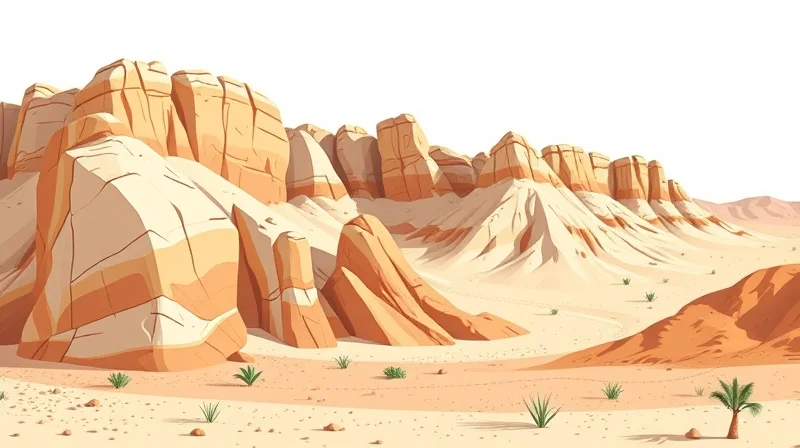
The Agafay desert is a stony, rocky landscape of arid clay hills and bare rock plateaus that sits close to Marrakech, at the foot of the High Atlas mountains. It is often called a 'lunar' or 'moon' desert because of its pale, sun-baked, almost treeless surface. The single most important thing to know before you go: Agafay is not the Sahara. It has almost no sand dunes. Its dramatic look comes from cracked clay, gravel plains and rocky ridges, not from a sea of golden sand.
Agafay lies southwest of Marrakech, roughly 30–40 km from the city, at around 600–700 metres of elevation. On a clear day you can see the snow-capped peaks of the High Atlas on the horizon, including Mount Toubkal (4,167 m), North Africa's highest mountain. That contrast — pale rocky desert in the foreground, high mountains behind — is what makes the area distinctive, and it is why so many short trips from Marrakech head here. This guide explains what Agafay actually is, why it differs from the Sahara, and how to visit it well.
What is the Agafay desert near Marrakech?
Agafay is a rocky, stony desert on the Marrakech plain, close to the city and at the foot of the High Atlas. It is made up of rolling grey-beige clay hills, dried riverbeds and rocky plateaus, with sparse, low vegetation. It is not a sandy dune desert.
Geographers would describe most of Agafay as a hamada and reg landscape — bare rock and gravel rather than sand (more on those terms below). Sitting at roughly 600–700 m elevation, it is high enough and exposed enough to feel arid and open, while the Atlas peaks behind it stay snow-capped for much of the year. That combination gives Agafay its reputation as the closest 'desert experience' to Marrakech, even though, strictly speaking, it is a semi-arid rocky steppe rather than a true sand desert.
If your mental picture of a Moroccan desert is tall orange dunes, Agafay will look different from what you expect — and that is exactly why it is worth understanding before you visit.
Why is the Agafay desert not the Sahara?
Agafay is not the Sahara because it is a rocky desert on the Marrakech plain, hundreds of kilometres north of the true Saharan sand seas — and because its surface is stone and gravel, not dunes.
The Sahara is the world's largest hot desert, and it includes vast sandy dune fields known as ergs. Morocco's famous Saharan dunes — places like Erg Chebbi (near Merzouga) and Erg Chigaga (near M'Hamid) — lie far to the south and southeast, well beyond the High Atlas. Reaching them from Marrakech means crossing the mountains and travelling a long way.
Agafay, by contrast, sits between Marrakech and the Atlas foothills. It is a rocky, clay-and-gravel desert, not a dune sea. So while people sometimes market it as 'the desert near Marrakech', it is geologically a different kind of desert altogether. Calling Agafay 'the Sahara' is simply inaccurate — and knowing the difference helps you set the right expectations. For a clear definition of what does and does not count as a sandy desert, see Britannica's overview of deserts and desert types.
What kind of desert is Agafay: hamada, reg or erg?
Agafay is best described as a mix of reg and hamada — gravel plains and bare rock — rather than an erg of sand dunes.
Geographers who study arid landforms use three main terms for desert surfaces:
- Erg — a sand sea, dominated by dunes. This is the classic 'Sahara' image. Agafay is not an erg.
- Reg — a plain covered in gravel, pebbles and small stones, often with a hard, wind-swept surface.
- Hamada — a bare, rocky plateau where wind has stripped away finer material, leaving exposed stone.
Agafay combines the last two: gravel plains, cracked clay and rocky ridges. Wind and the region's dry climate carry away lighter sand and dust, leaving behind a pale, hard, stony surface. That is why visitors describe it as 'moon-like' — it is the exposed skeleton of the land rather than soft dunes. The United States Geological Survey's public guide, Deserts: Geology and Resources, explains how wind and aridity produce exactly these gravel-and-rock desert surfaces.
Where exactly is the Agafay desert located?
Agafay is located southwest of Marrakech, between the city and the High Atlas foothills, within Morocco's Marrakech-Safi region.
It spreads across the arid hills near the Lalla Takerkoust reservoir, a dammed lake fed by Atlas snowmelt. This puts Agafay in an unusual position: a dry, rocky landscape with a body of water and high mountains close by. Orientation is simple — face away from Marrakech towards the mountains, and the pale hills rolling out in front of the Atlas are Agafay.
Because it is the closest desert-like scenery to the city, Agafay has become popular for short outings rather than multi-day expeditions. You do not have to cross the Atlas or spend long hours on the road to reach open, arid terrain. That accessibility is the whole appeal: a rocky-desert setting without the long journey a true Sahara trip requires. If you are weighing where to base yourself around the city, our getting-there guide covers how the main areas relate to each other.
Why does the Agafay desert look like the moon?
Agafay looks 'lunar' because its surface is rolling grey-beige clay hills and rocky ridges with almost no vegetation, no dunes, and a pale, cracked, sun-baked texture.
The ingredients are simple: bare clay and stone, sparse scrub, dried-out riverbeds (locally oueds) that only carry water after rare rains, and low ridges that catch the light. There is little green to break up the view, so the land reads as one continuous, muted surface — the reason the 'moon desert' nickname stuck.
Light changes it through the day. In the flat midday sun the hills look pale and washed out; in the early morning and late afternoon, lower light picks out every ridge and hollow, and the tones shift towards warmer greys and ochres. On clear days the snow on the High Atlas behind adds a sharp contrast. None of this is dramatic in the theatrical sense — it is a quiet, stark landscape, and that restraint is part of its character.
What can you do in the Agafay desert?
The main activities in Agafay are quad biking, camel and horse rides, hiking, mountain biking, and desert camps with dinner and stargazing.
Here is a factual rundown of the typical options:
- Quad biking and ATV rides — the firm, rocky tracks suit quads and 4x4s well, because the ground is compact rather than deep, soft sand. This is one of the most common reasons people come to Agafay.
- Camel and horse rides — slower-paced trips across the hills, often at sunrise or sunset.
- Hiking and mountain biking — the open terrain and gentle ridges make it walkable and rideable, though there is little shade.
- Desert camps — fixed camps offer dinner, music and stargazing after dark, taking advantage of the low light pollution away from the city.
The rocky ground is a genuine advantage for motorised activities: quads and 4x4s handle firm gravel and clay more predictably than they handle the deep dunes of a true erg. If you are deciding between styles of trip, our comparison of a quad-only versus quad-and-camel outing breaks down what each involves. For a practical planning question many people ask — sunrise or sunset — see sunset vs morning quad tours in Agafay.
A note on honesty: prices, ratings and availability change constantly and depend on the operator, so we do not quote them here. Live figures appear only in the booking widgets on our individual desert-tour pages.
When is the best time to visit the Agafay desert?
The most comfortable times to visit Agafay are spring and autumn, when daytime temperatures are generally mild. Summer is very hot on the exposed rock, and winter can be cold with snow on the nearby Atlas.
A simple seasonal guide:
- Spring (roughly March–May) and autumn (roughly September–November) — the easiest conditions, with warm but manageable days.
- Summer (June–August) — Marrakech regularly sees July highs around 37–38°C, and the open, shadeless rock of Agafay amplifies the heat. This is why most warm-season quad and camel trips run in the early morning or around sunset rather than midday.
- Winter (December–February) — days can be pleasant but mornings and evenings get cold, and the Atlas behind Agafay is often snow-capped.
Whatever the season, early morning and late afternoon give both the best light and the coolest, most comfortable conditions. Midday is the harshest time to be out on the rock. For current climate figures before you plan, Morocco's official tourism board at VisitMorocco.com is a useful starting point.
What should you bring and know before visiting?
Come prepared for strong sun, temperature swings and limited services: bring sun protection, plenty of water, closed shoes and layers.
Practical, evergreen advice:
- Sun protection — hat, sunglasses and high-factor sunscreen. There is very little natural shade.
- Water — more than you think you need, especially in the warmer months.
- Closed shoes — the ground is rocky and dusty; open sandals are a poor choice for quads, camels or hiking.
- Layers — mornings and evenings can be cool even when the middle of the day is hot, so a light jacket helps.
- Respect the environment and local communities — stay on established tracks, take your litter with you, and be considerate of people living and working in the area.
Because services are limited once you are out in the desert, plan ahead: know what your trip includes, carry any medication you need, and don't rely on finding shops or facilities nearby. If you are riding a quad, note that Moroccan law requires helmets for both driver and passenger; reputable operators supply helmets, goggles and usually gloves, but insurance cover varies, so always check what is included before you set off.
Is the Agafay desert worth visiting?
Agafay is worth visiting if you want a rocky, open, desert-like landscape and Atlas views close to Marrakech without the long trip to the true Sahara — as long as you arrive knowing it is stone and gravel, not a sea of dunes.
It suits travellers who are short on time, who want a taste of arid scenery and mountain backdrops, or who are drawn to activities like quad biking that work well on firm ground. It is a strong choice for a half-day or evening outing, or a night in a desert camp.
Who might be disappointed? Anyone whose heart is set on classic golden dunes. For that, you genuinely need to head south to the Saharan ergs — and that is a much longer journey. Set expectations correctly, though, and Agafay delivers exactly what it is: the closest, most convenient desert-style landscape to Marrakech. If you are still comparing it with other nearby options like the Palmeraie palm grove, our Agafay vs Palmeraie comparison lays out the differences.
Frequently asked questions about the Agafay desert
Is Agafay a real desert?
Yes, in the sense that it is a genuinely arid, sparsely vegetated landscape. Technically it is a rocky, stony desert (a hamada and reg landscape) rather than a sandy one, and some geographers would classify it as semi-arid steppe.
Does Agafay have sand dunes?
No, not in any significant way. Agafay's surface is clay, gravel and bare rock. If you want tall sand dunes, you need to travel south to the Saharan ergs such as Erg Chebbi or Erg Chigaga.
Is Agafay the same as the Sahara?
No. The Sahara is far to the south and includes vast sand seas, while Agafay is a rocky desert on the Marrakech plain near the High Atlas. They are different types of desert in different parts of Morocco.
Can you ride quads in Agafay?
Yes. The firm, rocky tracks are well suited to quads and 4x4s. No driving licence is required for tourist quad tours on private tracks, but Moroccan law requires helmets for driver and passenger, and the minimum age to drive is generally 16, with 16–17-year-olds usually needing an accompanying adult; younger children ride as passengers.
Can you see the High Atlas from Agafay?
Yes. On clear days the snow-capped peaks of the High Atlas, including Mount Toubkal (4,167 m), are visible on the horizon. That mountain backdrop is one of Agafay's defining features.
Planning a trip? If you're deciding which outing fits you best, start with our guide to the best quad tour in Marrakech for an honest, side-by-side look at the options.
Sources
- Encyclopaedia Britannica — Sahara
- Encyclopaedia Britannica — Desert (definition and desert types)
- U.S. Geological Survey — Deserts: Geology and Resources
- Office National Marocain du Tourisme — VisitMorocco.com
- UNESCO World Heritage Centre — Morocco (States Parties)