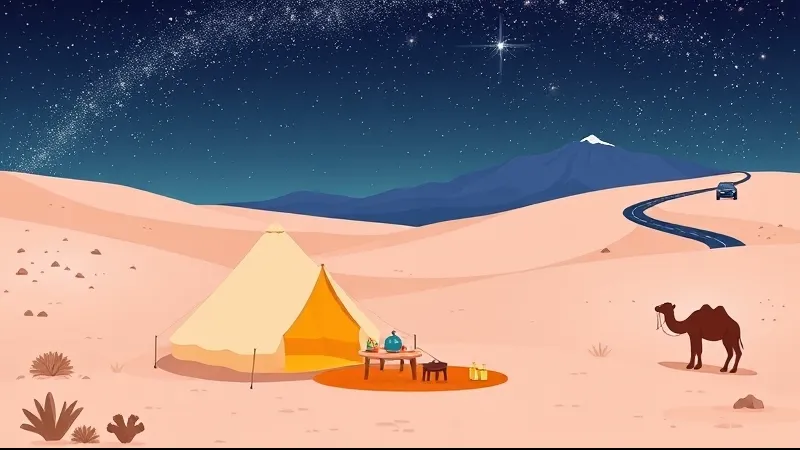
What is there to do in the Agafay desert besides quad biking?
Besides quad biking, the Agafay desert offers desert camps in several price tiers, sunset and candlelit dinners with an Atlas Mountain backdrop, camel and horse rides, dawn hot-air balloon flights, day-use pools, and stargazing evenings. Agafay sits roughly 30–40 km southwest of Marrakech and is normally reached in about 45–60 minutes by road, which is why most experiences are sold as half-day or evening formats with hotel pickup from the city.
One thing to be clear about from the start: Agafay is not the Sahara. There are no tall sand dunes. It is a hamada — a stony, lunar landscape of grey-white clay hills and dry riverbeds, and photographs that show golden dunes were not taken there. Read it as a landscape of texture, silence and mountain views rather than of sand. For general regional context, the Moroccan National Tourism Office is the official starting point.
Where exactly is Agafay, and how far is it from Marrakech?
Agafay lies southwest of Marrakech, in the direction of the Lalla Takerkoust reservoir and the Kik plateau, within the Al Haouz province. Camp entrances are typically 30–40 km from the city, and the transfer takes 45–60 minutes depending on traffic leaving Marrakech and on where in the zone the camp sits.
The part that catches people out is the last stretch. Most camps are reached by an unsurfaced piste of a few kilometres, and after rain those tracks rut quickly. A standard city car can manage some approaches and will struggle on others, which is why nearly every camp includes or strongly recommends its own transfer. Compare this with the real Saharan ergs at Merzouga or Zagora, which are a full day of driving each way and need several days to do properly — that distance gap is the entire reason Agafay is marketed as the desert closest to Marrakech.
Why is Agafay a rocky desert instead of a sand desert?
Because it is a hamada, not an erg. Agafay is a wind-scoured plateau of marl, clay and limestone at the northern foot of the High Atlas, shaped mainly by seasonal wadis cutting down through soft sediment rather than by wind piling up sand. The High Atlas casts a rain shadow over the Marrakech basin, producing a semi-arid climate with sparse, strongly seasonal rainfall — enough to green the hills briefly after winter rain, not enough to sustain continuous vegetation.
That geology explains the visitor experience directly. The surface is compact and stony, so it holds vehicle tracks for years; the crust is fragile; and the hills glare almost white at midday and turn warm ochre in the last hour of light, which is why so much of what happens in Agafay is scheduled around sunset.
What types of desert camps exist in Agafay, and how do they differ?
There are three broad formats, and they solve different problems:
- Day-use camps — pool access plus lunch, usually mid-morning to late afternoon. Popular in high summer, when the desert is only comfortable in and around water.
- Evening dinner camps — arrival before sunset, dinner and music, return to Marrakech the same night. This is the most-booked format and the one most often combined with a quad ride.
- Overnight camps — anything from simple Berber-style tents with shared washblocks to insulated tents with en-suite bathrooms, heating and full-night electricity.
The word luxury is used loosely across the whole zone, so judge by specifics rather than by the label. Before booking, check: private or shared bathroom; whether the generator runs all night or shuts down after dinner; heating in winter and air conditioning or shade in summer; whether Wi-Fi exists and whether it actually works; whether transfer is included or extra; minimum age; and whether alcohol is served, since many camps do not serve it at all.
Live prices, availability and ratings change by season and are not quoted anywhere in this article — read them from the booking widgets on the relevant desert tour pages.
What happens during a typical Agafay dinner and sunset evening?
The standard evening runs in a predictable order: pickup from your riad or hotel in the late afternoon, a transfer of roughly 45–60 minutes, arrival at camp with mint tea and Moroccan pastries, a short camel ride of a few loops around the camp, sunset from a ridge or terrace, then dinner — typically harira or a spread of cooked Moroccan salads, a tagine or couscous, and fruit — followed by Gnawa or Amazigh music and a fire circle before the drive back.
Pickup time shifts across the year because sunset does. In midwinter you may be collected in the middle of the afternoon and be back in the city early; in midsummer everything slides several hours later and the same tour ends close to midnight. Always confirm your pickup window the day before rather than assuming the time shown at booking. Vegetarian options and halal preparation are standard on request; alcohol is not.
How good is stargazing in Agafay compared with Marrakech?
Materially better than the city, but not a remote-observatory sky. Central Marrakech sits in a heavily light-polluted zone where only the brightest stars and planets survive. Move 30–40 km southwest and the improvement is immediate: the Milky Way becomes visible to the naked eye on clear, moonless nights, and camps away from the main access roads are darker still. The honest caveat is that the city's skyglow remains visible as a dome on the northeastern horizon, and camp lighting — string lights, pool lighting, generators — often does more damage to your night vision than the distant city does.
Two things decide whether you actually see anything. First, the moon: a night close to new moon is dramatically better than one near full moon, and moon phases are easy to look up in advance on timeanddate.com. Second, the season: the bright galactic core is a spring-to-early-autumn target from Morocco, while winter skies are clear and steady but show a fainter band. You can check the light-pollution zone yourself on the satellite-derived Light Pollution Map and read the Bortle framework at DarkSky International. That the region genuinely has good observing conditions is not a marketing claim: the Oukaïmeden observatory in the High Atlas, run with Cadi Ayyad University, hosts the TRAPPIST-North telescope — although that site is far higher and far darker than any Agafay camp.
If stargazing is your main reason for going, ask the camp whether lights are dimmed after dinner. Many will, if asked.
When is the best time of year to visit Agafay?
Spring and autumn, comfortably. Daytime temperatures in the 20–30°C range make the whole day usable, and evenings are cool rather than cold. July and August are the hard season: average July highs around 37–38°C in the Marrakech basin, with an all-time record of 49.6°C, which pushes activity into the early morning and the golden hour and makes day-use pool camps the sensible summer choice.
Winter reverses the problem. Days are pleasant and clear, but the desert loses heat fast after sunset and camps depend on braziers, blankets, hot-water bottles and heated tents — worth confirming before you book a January overnight. Late winter into spring is the greenest the hamada gets, after the rain. For climate normals rather than a single year's weather, use the Direction Générale de la Météorologie and the World Bank Climate Change Knowledge Portal.
What should you pack for an evening or overnight in Agafay?
Pack for a temperature swing rather than for an average. Semi-arid air holds little heat, so the drop between a warm afternoon and midnight is large enough that people who came out in a T-shirt regularly spend the evening wrapped in a camp blanket.
- Layers, plus a windproof jacket — yes, even in summer
- Closed shoes; the ground is stony and uneven, and sandals are a poor choice around a fire circle
- Headlamp or torch, since paths between tents are often unlit
- Power bank, because generator hours are limited at many camps
- Wide-brim hat, sunglasses and sunscreen for day-use visits
- Refillable water bottle
- Modest clothing that covers shoulders and knees for arrivals and departures through villages, in line with local norms in a Muslim-majority country
- For night photography: a tripod, a fast wide-angle lens, and exposures kept short enough to avoid star trails
For general safety and health guidance, check your own government's advice page — for English-speaking readers, the UK FCDO Morocco travel advice.
Can you combine a quad tour with a camp dinner in the same trip?
Yes, and it is one of the most common ways to visit. The usual build is a quad ride of 1–2 hours, a short camel ride, then dinner at a camp; a variant swaps dinner for a day-use camp with pool access. Budget most of a day door to door from Marrakech once transfers, briefing and the meal are counted — a quad ride alone is typically 2.5–3 hours including pickup and return.
Be realistic about two things. Combined tours usually shorten each component, so the quad section is at the shorter end of the range. And quad riding in Agafay is dusty; most camps offer a basin or a shower stop before dinner, but bring a change of top if you care. Helmets are mandatory for driver and passenger under Moroccan law, no driving licence is required on the private tracks used by tour operators, and operators typically set a minimum driving age of 16 — younger children ride as passengers on double quads. Operators supply helmet, goggles and usually gloves; insurance coverage varies between operators, so ask exactly what is included before you ride.
Comparing formats? Our side-by-side breakdown of the quad, camel and dinner combination sets out what is and is not included, with live prices and current reviews shown in the booking widget on that page — nothing is quoted from memory here.
Is Agafay suitable for families, older travellers and people with limited mobility?
Partly, and it depends heavily on the individual camp. The terrain is stony and uneven, paths between tents are loose underfoot, and access tracks are unpaved — so wheelchairs and standard strollers are difficult at most camps. Some of the larger camps have graded paths and can drop a vehicle close to the dining area; that is a question worth asking directly, by email, before booking.
For families, camel rides usually have a minimum age set by the operator, quad passenger rules vary, and camp pools are often unfenced and unsupervised. For older travellers, heat is the main risk factor in summer, and the nearest full hospital facilities are back in Marrakech, roughly 45–60 minutes away by road. Travel insurance that covers adventure activities is a sensible baseline.
How do you get to Agafay independently — and do you need a rental car?
Most visitors do not need a car, because a private transfer is bundled into camp and tour bookings. The realistic independent options are a grand taxi negotiated for the round trip, an organised shuttle, or a rental car. Petit taxis are restricted to the urban perimeter and are not a way to reach the camps.
If you do drive, note that some rental agreements exclude unsurfaced roads, which is precisely what the final approach to many camps is. GPS pins for camps are frequently inaccurate — several camps share similar names and sit on tracks that mapping apps render optimistically. Ask the operator for exact coordinates plus a named meeting point, and confirm by phone on the day. Moroccan road rules, speed limits and documentation requirements are published by the Ministry of Transport and Logistics. Our transport overview covers getting around the Marrakech area more broadly.
What environmental and community issues should visitors be aware of?
Four, and none of them require alarm — just informed questions. Water is the first: camps with pools and en-suite bathrooms draw on a basin that has been under sustained drought pressure, with the nearby Lalla Takerkoust reservoir repeatedly falling to low fill levels. Second, waste and generator noise, in a zone with no municipal infrastructure. Third, off-piste driving, which scars the hamada crust for years because nothing regrows quickly on it. Fourth, camp lighting, which is steadily eroding the night sky that people travel out to see.
Useful things you can actually do: ask where the camp's water comes from and whether it uses solar; stay on marked tracks on any quad or 4x4 excursion; and favour operators that employ staff from the nearby douars. National statistics and water-resource data are published by the Haut Commissariat au Plan and by FAO's AQUASTAT country profiles.
How does Agafay compare with the Palmeraie, Jbilat and the real Sahara?
- Palmeraie — the palm grove on the northern edge of Marrakech, about 20 minutes away. Shortest transfer, easiest half-day, and honestly not wilderness: you ride between palms, tracks, walls and villas. Best for a short first ride or for families short on time.
- Jbilat (Jbilet) — the bare hills north of the city. More open and more varied riding than the Palmeraie, popular for quad and buggy, without the camp-and-dinner infrastructure of Agafay.
- Agafay — 30–40 km southwest, 45–60 minutes. The best of the three for dinners, overnight camps, stargazing and an Atlas backdrop, and the only one where a full evening programme makes sense.
- Merzouga and the Erg Chebbi dunes — the actual Sahara, with tall sand dunes, but a full day of driving each way and a minimum of two to three days as a trip. If sand dunes are non-negotiable, no Marrakech day trip substitutes for it.
For a direct head-to-head on riding terrain, see Agafay vs Palmeraie, and for timing, sunset vs morning departures.
How should you budget and book an Agafay experience?
Think in cost drivers rather than fixed figures, because rates move seasonally. What pushes the price up: a private rather than shared transfer; overnight rather than day-use; en-suite rather than shared bathrooms; smaller and more exclusive camps; and peak windows around Easter, Christmas and New Year, when the better camps sell out weeks ahead.
When comparing listings, weight recent reviews more heavily than total counts — camps in Agafay change management and standards faster than their review histories suggest. Check the cancellation window, which on the major booking platforms is commonly free cancellation up to a day before. This site is an independent comparison guide, not a tour operator: every live price, availability slot and rating you see comes from the booking widgets embedded on each tour page.
Frequently asked questions
Does the Agafay desert have sand dunes?
No. Agafay is a hamada — a stony desert of grey-white clay and limestone hills, dry riverbeds and compact ground. Marketing images showing tall golden dunes were taken elsewhere, usually at Erg Chebbi near Merzouga. Agafay's appeal is the lunar terrain and the High Atlas skyline behind it, not sand.
How long is the drive from Marrakech to Agafay?
Roughly 45–60 minutes from central Marrakech to most camp entrances, covering about 30–40 km southwest. Add time for city traffic at the start and for the final unpaved track, which slows any vehicle. Nearly all camps include or arrange the transfer, which also solves the navigation problem.
Can you see the Milky Way from Agafay?
On a clear night close to new moon, yes — the band is visible to the naked eye once your eyes adapt. It is far better than central Marrakech, but not a pristine sky: the city's glow shows on the northeastern horizon and camp lighting reduces contrast. Ask whether lights are dimmed after dinner.
Do Agafay camps have electricity, Wi-Fi and mobile signal all night?
It varies by camp. Mobile coverage is generally usable across the zone. Wi-Fi is often advertised but frequently slow or limited to the main tent. Electricity commonly runs on a generator or solar with battery storage, and some camps cut power after a set hour — bring a power bank and confirm before booking.
Is alcohol served, and what should you wear?
Some camps serve alcohol, many do not, and a few allow you to bring your own — check in advance rather than assuming. For dress, comfortable, modest clothing covering shoulders and knees is appropriate, with layers and a windproof jacket for the evening and closed shoes for the stony ground.
Sources
- Moroccan National Tourism Office (visitmorocco.com) — official regional and destination context for the Marrakech area.
- UNESCO World Heritage Centre — Medina of Marrakesh (ref. 331) — heritage context for the city visitors depart from.
- Direction Générale de la Météorologie du Maroc — Moroccan climate normals and seasonal temperature patterns.
- World Bank Climate Change Knowledge Portal — Morocco — long-term climate and aridity data for the Marrakech basin.
- DarkSky International — light-pollution concepts and the Bortle sky-brightness framework.
- Light Pollution Map (VIIRS satellite data) — check the light-pollution zone of a specific camp location yourself.
- ESO — TRAPPIST telescopes — TRAPPIST-North at the Oukaïmeden observatory, evidence of regional sky quality.
- timeanddate.com — moon phases, Marrakech — moon-phase planning for stargazing nights.
- Haut Commissariat au Plan — Moroccan national statistics, including water and regional data.
- FAO AQUASTAT country profiles — water resources and drought pressure in Morocco.
- Ministry of Transport and Logistics, Morocco — road rules, speed limits and driving requirements.
- UK FCDO — Morocco travel advice — safety, health and entry guidance for English-speaking readers.