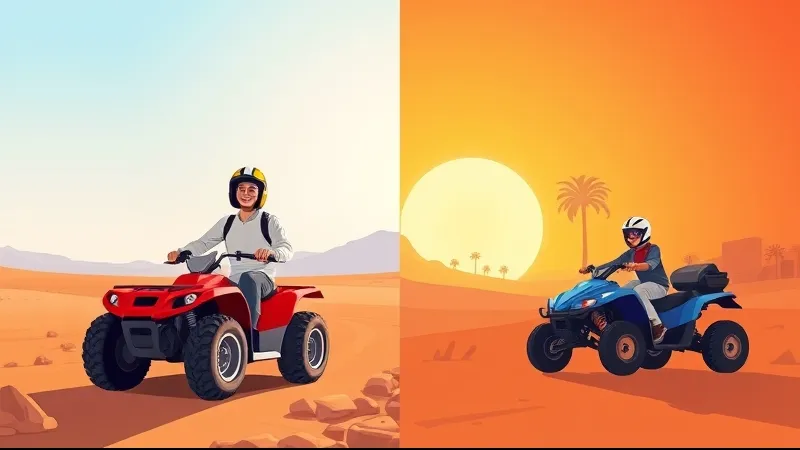
Is early morning or golden hour better for a quad tour in Marrakech when the forecast passes 40°C?
Early morning is the cooler and more stable option. Air temperature in Marrakech reaches its lowest point shortly before sunrise, so the first departure of the day puts you on the quad while the ground has had the whole night to shed its heat. Golden hour — the last stretch of light before sunset — gives you better photographs and a much lower UV index, but it starts from air, rock and asphalt still loaded with the day's heat, so what the thermometer says and what you feel can diverge.
The slots to avoid are the ones in the middle: midday through late afternoon, when Marrakech is at its daily peak. Both viable options usually appear on the same operators' calendars for the same tours, at comparable conditions. That means the choice is about comfort versus light, not about paying less. If you are travelling with children, older relatives or anyone who handles heat poorly, book the morning. If you are there for the photographs and you can tolerate residual heat, take the evening.
For climate normals and heat bulletins, Morocco's national weather service, the Direction Générale de la Météorologie, is the reference source.
How hot does Marrakech actually get in summer, hour by hour?
Hot enough that the departure time matters more than any other booking decision you make. Marrakech sits inland in the Haouz plain, away from the Atlantic moderation that keeps Essaouira and Casablanca mild, and average July highs run around 37–38°C, with a record of 49.6°C. Spring and autumn, by contrast, sit in a comfortable 20–30°C band, which is why those are the seasons most guides recommend for riding.
The daily curve is what makes or breaks a summer tour. The coolest moment falls in the half hour or so before sunrise. Temperature climbs steeply through the morning, peaks in the mid-to-late afternoon, then falls slowly — much more slowly than it rose, because stone, gravel and tarmac keep radiating stored heat long after the sun is low. That lag is the whole reason an evening ride can feel warmer than the numbers suggest.
For regional heat records and long-term trends, see the World Meteorological Organization and the Copernicus Climate Change Service.
What time does the sun rise and set in Marrakech in summer?
Every summer slot is anchored to the sun, not to the clock, so check the actual times for your date. In late June and July, sunrise in Marrakech comes early and sunset comes late — late enough that a "sunset" tour can finish well after most restaurants would expect you for dinner. By late August, sunset has moved appreciably earlier, which compresses the evening slot and shifts pickup times accordingly.
There is one detail most guides skip. Morocco stays on UTC+1 year-round and reverts to UTC+0 only for the Ramadan period. When that switch happens, every published pickup time on every operator's calendar moves with it. If your trip falls near the changeover, confirm the local departure time against the date rather than assuming the schedule you saw online still applies.
For exact sunrise and sunset figures, use the NOAA Solar Calculator or the US Naval Observatory astronomical data service.
What does the early morning slot feel like in Agafay, the Palmeraie and Jbilat?
It feels like a different excursion from the same route ridden at midday. The air is dry and still, dust settles faster and hangs less in the track, and the stony ground of Agafay has not yet begun to throw heat back at you. Helmet lining, gloves and handlebars are all at ambient temperature when you start, which matters more than riders expect — kit that is already warm at the first stop stays warm.
In Agafay, morning also buys you visibility. The view toward the Atlas foothills is clearest before the afternoon haze builds. In the Palmeraie, the palm canopy is still holding the night's coolness and the irrigation channels keep the air marginally damper. In the Jbilat hills, the wind that crosses the open ridges is a help rather than a hot blast.
The honest trade-off: morning light is flat and high-contrast, and it is less flattering for photographs than the evening. Most operators run the first departure as their busiest slot in July and August, so it books out first.
What does the golden hour slot offer, and what are its limits?
Golden hour offers light you cannot get at any other hour, plus a UV index that has usually dropped from extreme to low. Low side-light picks out the ridges and dry riverbeds of Agafay and rakes across the palms of the Palmeraie; the same landscape that looks washed out at 10am reads as three-dimensional an hour before sunset. If your priority is photographs, this is the slot.
The limits are physical rather than a matter of opinion. Soil, rock and asphalt release stored heat for hours after the peak, so perceived temperature at the start of an evening ride can still exceed what you would have felt in the morning, even when the air reading is lower. Dust also becomes harder to see through against a low sun, which slows the group down. And evening tours end at or after dark, so the return transfer runs at night.
The WHO guidance on the Global Solar UV Index explains why the UV argument for evening is real even when the heat argument is not.
How far are Agafay, the Palmeraie and Jbilat, and how long is the transfer?
Far enough that transfer time changes what your booked slot actually means on the ground.
| Zone | Direction | Typical transfer from Marrakech | |---|---|---| | Palmeraie | Northern edge of the city | About 20 minutes | | Jbilat hills | North of the city | Longer than the Palmeraie, shorter than Agafay | | Agafay | Southwest, via the Lalla Takerkoust axis | 45–60 minutes, for a site 30–40 km out |
Read those numbers against your pickup time. An early hotel pickup for the Palmeraie has you on the quad within roughly half an hour, still in the coolest part of the morning. The same pickup time for Agafay means you start riding closer to an hour later, by which point the temperature has already begun climbing. If you want the genuinely cool end of the morning in Agafay, you need the earliest departure on the calendar, not the second one.
Typical ride time is 1–2 hours on the quad, with 2.5–3 hours total including transfers. Hotel or riad pickup is usually included; the live durations and inclusions for each tour appear in the booking widget on its page.
How does terrain change which slot you should book?
The less shade and the more exposed rock, the stronger the case for the first departure of the day.
Agafay is a rocky, stone desert — often described as lunar, and worth stating plainly that it is not the Sahara and has no dunes. It is open, exposed and effectively shadeless, and the stony surface stores and re-radiates heat efficiently. That makes it the zone where the morning argument is strongest in July and August.
The Palmeraie is the palm grove on the northern edge of Marrakech. It is not wilderness, and you will ride past walls, tracks and hotel access roads as well as palms — but the partial canopy and the irrigation channels genuinely moderate how the heat feels, which makes an evening ride there more tolerable than the same slot in Agafay.
The Jbilat are low, arid hills north of the city: dusty tracks, little cover, more wind exposure. Treat them like Agafay for slot selection. A side-by-side breakdown is in our Agafay vs Palmeraie comparison.
What should you wear and carry for a quad ride in extreme heat?
Cover more skin than instinct suggests. Closed shoes are non-negotiable, and long, light-coloured trousers protect against exhaust heat and rock spray thrown up by the quad ahead of you — protection outweighs the small extra warmth. Add a buff or light scarf for dust, wraparound eye protection under the visor, and high-SPF sunscreen applied well before departure, then reapplied.
Operators provide a helmet, goggles and usually gloves. Insurance coverage varies between tours, so check what is actually included before you book rather than assuming.
On hydration, follow published guidance on fluid replacement during exertion in heat rather than a made-up litre figure — start hydrated, drink at every stop, and remember that a closed helmet traps heat around your head, which makes the cooldown stops functional rather than optional. Practical country-specific advice is on the CDC Travelers' Health page for Morocco and the WHO heat and health fact sheet.
What are the signs of heat stress you should recognise on a desert excursion?
Learn the difference between heat exhaustion and heat stroke before you ride. Heat exhaustion typically shows as heavy sweating, weakness, nausea, headache, dizziness or muscle cramps. It is manageable: stop, get into shade, cool down, take fluids, and tell the guide.
Heat stroke is the medical emergency. The red flags are confusion or altered behaviour, hot dry skin, and sweating that has stopped. That combination needs immediate cooling and emergency medical help — it is not something to ride through to the end of the loop.
The protocol is the same on every guided tour: stop, shade, cool, fluids, call the guide. Groups ride together and stopping the group is normal and expected, not an inconvenience. Guides in Agafay and Jbilat run these routes daily in summer and build in breaks precisely because riders overheat. Say something early rather than at the point where you can no longer assess yourself clearly.
Who should choose the morning slot and who should choose golden hour?
Use a decision framework, not a verdict.
Choose the morning if you are travelling with children, you are over 60, you have a cardiovascular or respiratory condition, this is your first time on a quad, or you plan to combine the ride with a full day of sightseeing. Morning also protects the rest of your day: you are back in the city before the worst of the heat.
Choose golden hour if photography is the point, you are travelling as a couple and want the light, you land at midday and cannot make an early start, or you are pairing the ride with a dinner or camp experience in Agafay.
The hybrid answer for July and August: morning is the safer default in Agafay and Jbilat, while the Palmeraie handles an evening slot better. If you are weighing the two for Agafay specifically, our sunset vs morning quad comparison sets them side by side.
How do you book and compare quad tours without guessing at prices?
Check the live widget, not the prose. This site is an independent comparison guide, not a tour operator, so prices, durations, group sizes, ratings and availability come from the booking widget on each tour page rather than from figures written into an article that would be out of date within a season.
Before you confirm, open the widget and verify five things for your specific date: the exact departure time, whether hotel pickup is included and from which zones, the minimum age and any licence requirement, what the insurance actually covers, and the cancellation window.
On licences: no driving licence is required for tourist quad tours, because they run on private tracks. Moroccan law requires helmets for both driver and passenger. Operators typically set a minimum driving age of 16, with 16–17-year-olds accompanied by an adult; younger children ride as passengers on double quads.
Start here: compare the shortlisted options side by side on our quad tour comparison hub, then open the widget on the tour you prefer for live times and conditions.
How can you plan the rest of the day around a summer quad tour?
Build the day around the heat window rather than fighting it.
After a morning ride, you will be back in the city with the hottest hours ahead of you. That block suits indoor and shaded options: the museums, courtyards and riads of the UNESCO-listed Medina of Marrakesh, the Majorelle garden early or late in its opening hours, or a hammam. Do not plan to walk the souks at the peak.
Before a golden-hour ride, treat the same window as rest time. Walking the medina all afternoon and then riding a quad in residual heat is the combination that produces the problems described above.
Factor the return leg in as well: from the Palmeraie you are back in the medina in roughly the time it took to get out, while Agafay evening tours end after sunset and return in the dark. Route and access notes are on our Palmeraie and Jbilat tour page, and general trip planning is on Visit Morocco, the official national tourism board.
Frequently asked questions
Is 40°C too hot to ride a quad in Marrakech?
Not if you ride at the right hour. Average July highs of 37–38°C make midday and afternoon riding a poor idea, but early morning and golden-hour slots run throughout summer. Sun exposure, hydration and covered skin matter more than the headline number. Anyone with a heart or lung condition should take the morning slot.
What is the coolest hour of the day in Marrakech?
The half hour before sunrise is the coolest point of the 24-hour cycle. That is why operators schedule their first departure to put riders on the quad as close to sunrise as the transfer allows. For Agafay, with a 45–60 minute transfer, only the earliest pickup of the day actually captures that window.
Is Agafay hotter than Marrakech city?
It feels hotter during the day even when readings are similar. Agafay is rocky, open and effectively shadeless, so stone re-radiates heat and there is nowhere to step out of the sun. The Palmeraie, with partial palm canopy and irrigation channels, feels cooler than both. Remember Agafay is stone desert, not Sahara dunes.
Do you need a driving licence, and can children ride?
No licence is required, because tourist quad tours run on private tracks. Helmets are legally required for driver and passenger. Operators typically set the minimum driving age at 16, with 16–17-year-olds accompanied by an adult. Younger children ride as passengers on double quads rather than driving their own machine.
How long is a standard quad tour, including transfers?
Plan for 1–2 hours of actual riding and 2.5–3 hours door to door. The difference is transfer time: about 20 minutes each way for the Palmeraie, 45–60 minutes each way for Agafay at 30–40 km southwest of the city. Hotel or riad pickup is usually included — confirm your zone in the widget.
Sources
Figures in this guide were checked against the sources below; live tour data (prices, times, availability, ratings) comes from the GetYourGuide widgets on each tour page and is not reproduced in the text.
- Direction Générale de la Météorologie du Maroc (marocmeteo.ma) — Marrakech climate normals and extreme-temperature bulletins
- World Meteorological Organization — regional heat records and verification
- Copernicus Climate Change Service — North African summer temperature trends
- WHO — ultraviolet radiation and the Global Solar UV Index
- WHO — climate change, heat and health
- CDC Travelers' Health — Morocco
- NOAA Solar Calculator and US Naval Observatory astronomical data — sunrise and sunset times
- UNESCO World Heritage Centre — Medina of Marrakesh
- ONMT / Visit Morocco — official national tourism board
- NARSA — Agence Nationale de la Sécurité Routière — Moroccan road-safety and licence rules