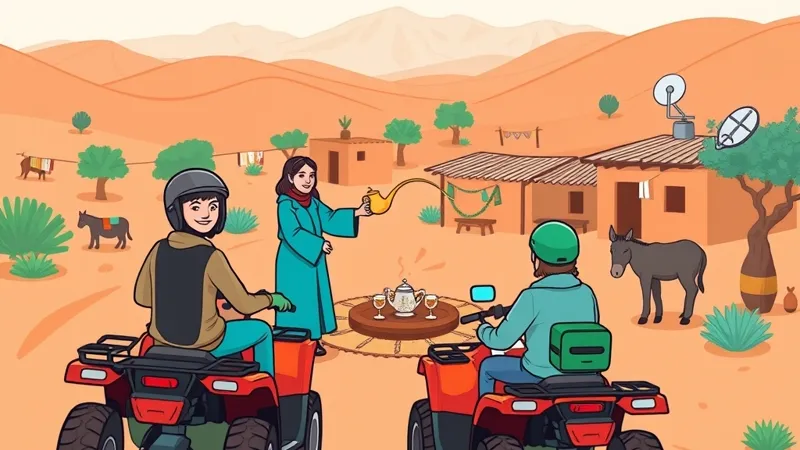
What is the cultural side of a Marrakech quad tour?
A quad tour around Marrakech is rarely only off-road driving. Most itineraries put you on the machine for one to two hours, with two and a half to three hours door to door once hotel or riad pick-up is counted, and almost all of them build in a stop for Moroccan mint tea — in a village household, a small café or a Berber-style tent. Between the throttle bursts, what you actually see is ordinary rural Morocco: pisé (rammed-earth) walls the colour of the ground they were dug from, seguia irrigation channels and the shafts of old khettara galleries, donkeys carrying fodder, olive and palm groves, bread ovens, children walking home from school.
Three zones carry nearly all the traffic. The Palmeraie, the palm grove on the northern edge of the city, is roughly twenty minutes away by transfer. The Jbilat (Jbilet) hills lie north of Marrakech, dry and dark-ridged. The Agafay stone desert sits about 30–40 km south-west, a 45–60 minute transfer. On clear days the High Atlas fills the southern horizon, and the city itself — whose medina is a UNESCO World Heritage site — is only ever a short drive behind you. Official practical information for visitors is published by the Moroccan tourism board on Visit Morocco.
Where do quad tours actually stop for mint tea near Marrakech?
There are three standard settings, and which one you get depends entirely on the zone you booked.
- A Palmeraie douar. A family home or a small village café among the palms, usually with plastic chairs, a low table and a courtyard. This is the closest thing to a domestic setting on any Marrakech quad route.
- A Berber-style tent camp on the Agafay plateau. Purpose-built for visitors, with carpets, cushions and a view over the hammada. Comfortable and photogenic, but it is hospitality staged for tourism, not a household.
- A roadside village terrace in the Jbilat. Simpler, dustier, often just a shaded terrace where the guide knows the owner.
The stop is normally included in the tour price rather than paid separately, and it lasts long enough for the tea to be poured properly rather than gulped. It also has a practical function: it is when guides refuel, check tyres and pressures, let the dust column settle and regroup riders who have fallen behind. If the tea break is the part of the day you care about most, the Palmeraie quad and tea break format is built around it.
How is Moroccan mint tea prepared and what does the ritual mean?
The recipe is consistent across the Haouz plain. Chinese gunpowder green tea is rinsed with a first splash of boiling water that is discarded, fresh spearmint (Mentha spicata, locally naânaâ) is packed into the pot, sugar is added — traditionally chipped from a cone-shaped loaf — and the berrad, a brass or stainless teapot with a long curved spout, goes back on the heat. The tea is then poured from height into small glasses, which aerates it, cools it slightly and builds the layer of foam that a well-made glass is judged by. It is often poured back into the pot and out again until the strength is right.
The custom of three glasses, each said to taste different as the leaves keep steeping, frames tea as something you sit down for rather than something you drink and leave. Accepting at least one glass is the polite response to an offer of hospitality; refusing outright reads as a rebuff, though saying you will take one and no more is perfectly acceptable. Moroccan food traditions are recognised internationally — couscous is inscribed on UNESCO's Representative List of the Intangible Cultural Heritage of Humanity — and tea service sits in the same register of everyday ceremony.
Who are the Amazigh (Berber) communities around Marrakech?
The people you pass are Amazigh, the indigenous population of North Africa; "Berber" is the older exonym still used in tourism. Tamazight is recognised as an official language of Morocco alongside Arabic in Article 5 of the current Constitution, and the Tifinagh script used on public signage was standardised by the Institut Royal de la Culture Amazighe (IRCAM).
Around Marrakech the dominant group is Tachelhit-speaking (Chleuh), with roots in the High Atlas and the Souss valley to the south. Many households are bilingual in Tachelhit and Moroccan Arabic (Darija), and younger people often add French.
One framing matters more than any statistic: the villages on quad routes are working agricultural communities, not open-air museums. Households farm olives, cereals and palms, keep sheep and goats, and commute into Marrakech for work in construction, hospitality and transport. If you want real population and household data for the rural communes of the Marrakech-Safi region, the Haut-Commissariat au Plan publishes census results — a far better source than the round numbers repeated in tour brochures.
What do the villages and tracks look like between Marrakech and the Atlas?
Each zone has a distinct texture, and none of them looks like the Sahara.
The Palmeraie is a historic irrigated palm grove on the city's northern edge, planted in stages since the Almoravid period and fed for centuries by khettara — gently sloping underground channels that bring groundwater to the surface by gravity, their access shafts still visible as lines of low earth rings. Be honest about what it is today: a mixed landscape of palms, market gardens, mud-brick hamlets, luxury hotels, walled villas and tarmac. It is countryside on the city's doorstep, not wilderness.
The Jbilat hills north of Marrakech are bare, eroded ridges of dark shale and quartzite, with thin cereal fields in the hollows and scattered douars where the tracks are the roads. This is the driest, dustiest and most open of the three.
Agafay is a stone desert — hammada — of pale, rounded hills cut by dry riverbeds, with the Atlas rising behind. Say it plainly: there are no sand dunes in Agafay. Visitors who expect Saharan scenery are consistently surprised, which is why it is worth deciding between Agafay and the Palmeraie before booking rather than after.
Everywhere you will see the same building vocabulary: pisé walls, flat roofs, reed shading, olive terraces, threshing floors of beaten earth, and stacks of palm fronds used for fencing and fuel.
How far are the Palmeraie, Jbilat and Agafay from central Marrakech?
The practical shape of the day is this. The Palmeraie is the closest zone, around twenty minutes by transfer from the city centre, which makes it the easiest half-morning option. The Jbilat hills lie north of Marrakech and take longer to reach than the Palmeraie but less than Agafay; combined Palmeraie and Jbilat itineraries trade a little transfer time for emptier tracks. Agafay is about 30–40 km south-west, a 45–60 minute transfer each way.
Count on a half-day commitment in every case: roughly two and a half to three hours in total for a standard tour, longer if you add a camel ride, a meal or a swim stop.
One detail catches people out. If you are staying inside the medina, a car cannot reach your riad — pick-up will be at a meeting point on the edge of the pedestrian zone, sometimes a five- or ten-minute walk with a porter. Confirm the exact duration, the pick-up window and the meeting point on the booking widget of the specific tour page, since these vary by operator and season.
What is the etiquette for visiting a Berber village on a quad tour?
The basics are simple and go a long way.
- Greet people. Salam ou alaikum in Arabic, azul in Tachelhit. A greeting before a camera is the single biggest difference between a welcome guest and a nuisance.
- Accept at least one glass of tea, even if you only sip it.
- Remove your shoes when entering a home, and follow your host's lead on where to sit.
- Do not walk into courtyards, doorways or fields uninvited. Domestic space is private.
- Cover shoulders and knees, even in heat. Long, loose clothing is also better against sun and dust.
- Slow down through inhabited douars. Dust and engine noise are the real friction points between quad tourism and residents — far more than the visitors themselves. Riding at walking pace past houses, animals and children costs you nothing.
During Ramadan, which moves through the calendar each year, tea may not be served during daylight hours and your hosts will be fasting. Tours still run; eat and drink discreetly, and expect the rhythm of villages to shift towards the evening.
Can you photograph people and villages during the tour?
Ask first, every time — and especially before photographing women and children. Some families will agree, some will decline, and a decline is not negotiable. Landscapes, tracks, animals and architecture are uncontroversial; faces are not. Avoid photographing inside homes unless you are invited to.
Operationally, most operators expect cameras and phones to come out at stops rather than while riding, and some rent or lend an action camera mounted on the quad or helmet for the moving footage. Keep the phone zipped away on the track: a dropped device on a stony piste is usually a destroyed device.
Two practical notes. Dust coats lenses within minutes, so carry a microfibre cloth and clean before shooting rather than after. And the light is best in the first couple of hours after sunrise and the last couple before sunset — the same windows when the low sun makes the dust visible and the pisé walls glow. General visitor guidance is published by the national tourism board on Visit Morocco.
What should you wear and bring for a dusty cultural ride?
Dress for dust first, heat second. Marrakech sits on the hot, dry Haouz plain: average July highs run around 37–38 °C, with an all-time record of 49.6 °C, while spring and autumn typically deliver a comfortable 20–30 °C. Climate data for Morocco is published by the Direction Générale de la Météorologie, and station normals are available through the WMO World Weather Information Service.
Bring:
- Closed shoes — trainers or boots, never sandals.
- Long sleeves and long trousers, loose and light.
- A buff, scarf or shesh for your mouth and nose. This is the single most useful item.
- Sunglasses, though goggles are normally supplied with the helmet.
- High-factor sunscreen for any exposed skin, plus lip balm.
- Small dirham notes for tips or a purchase at the tea stop; card payment is not realistic in a douar.
- A fleece or windproof layer for winter and early-morning departures, when it is genuinely cold before the sun clears the horizon.
Operators provide a helmet, goggles and usually gloves. Helmets are compulsory under Moroccan law for both the driver and the passenger. Insurance coverage varies significantly between operators — check exactly what is included, and what the excess is, before you sign anything.
Is a quad the best way to see Berber culture, compared with camel, buggy or 4x4?
Honestly: a quad is the best compromise between range and access, not the best vehicle for conversation.
- Quad. Reaches hamlets and tracks that coaches cannot, covers a lot of ground in one to two hours, and puts you at eye level with fields and walls. The trade-off is noise and helmets: you talk at stops, not while moving. Best for riders who want landscape plus a genuine tea stop.
- Camel ride. Slower, quieter, walking pace, almost always in the Palmeraie, and typically about an hour. You can hold a conversation with the handler, but you will see one small area. Best for families, nervous riders and anyone prioritising atmosphere over distance.
- Buggy. Two seats side by side, so a couple can actually talk, with a car-like driving position. More expensive per person and bulkier on narrow village lanes.
- 4x4 day trip. Reaches the Atlas valleys such as Ourika or Imlil, with a real village visit and a walk, but spends much of the day on tarmac. Best if mountain scenery and time on foot matter more than off-road driving.
Many visitors solve this by combining formats. If that is you, compare quad-only against quad plus camel before booking — the combined half-day gives you both the range and the slow, quiet section.
What time of year and time of day work best for this kind of tour?
Spring (March–May) is the strongest all-round window: the Haouz plain is green, wildflowers show on the Jbilat slopes, and daytime temperatures sit in the comfortable 20–30 °C band. Autumn (September–November) offers similar stability with drier ground and heavier dust. Winter brings crisp air, the clearest views of snow on the High Atlas and near-empty tracks, at the price of genuinely cold mornings and short daylight. Summer is workable only at the edges of the day — with average July highs around 37–38 °C, midday riding in full protective gear is unpleasant and operators shift to early-morning or golden-hour departures.
Time of day changes what the tour is about. Morning tours cross villages during working hours: children going to school, bread being baked, fields being irrigated, more people out and more chance of contact. Sunset tours prioritise light and temperature over encounters — the landscape is at its best, the douars are quieter, and the tea stop often happens in near-darkness.
How much does a cultural quad tour near Marrakech cost, and what is included?
A standard inclusion list covers the quad itself, helmet and goggles (usually gloves too), fuel, a guide, hotel or riad transfer, and the mint tea stop. Commonly excluded or charged as extras: tips, a second passenger on a double quad, action-camera rental, and add-ons such as a camel ride, a meal or a pool stop.
We do not publish prices in our articles, and you should be sceptical of any guide that does: rates change with season, group size, duration and operator, and a figure written months ago is simply wrong by the time you read it. Live prices, current traveller ratings and the exact inclusion list appear in the booking widget on each tour page — that is the only number worth trusting. Insurance is the item to read most carefully, because coverage genuinely varies.
Tipping guides is customary in Morocco and discretionary in amount. Small dirham notes, handed over at the end, are the norm.
How can visitors make sure the villages actually benefit?
The economics of a quad tour do not automatically reach the douar you ride through. A few choices change that.
- Favour operators who employ guides from the villages on the route and who pay the households hosting the tea stop. Ask — the answer, and the way it is given, tells you a lot.
- Buy directly from village co-operatives rather than from roadside middlemen. Women's argan co-operatives in the wider region are the clearest example; argan production is recognised by UNESCO through the inscription of argan, practices and know-how concerning the argan tree.
- Do not hand out sweets, pens or money to children. It teaches begging from passing vehicles, which is dangerous on tracks used by quads, and it undercuts the schools these families rely on.
- Respect water. The Haouz basin is under documented, long-running water stress; the World Bank's Morocco country programme publishes analysis of water scarcity and agriculture. Do not treat a village well as a photo prop or a place to rinse gear.
- Keep speed and noise down near homes, animals and fields. It is the cheapest form of respect available.
Frequently asked questions about the cultural side of a Marrakech quad tour
Do all quad tours near Marrakech include a mint tea stop?
Most do, but not all, and the wording matters. Look for "mint tea break" or "Berber tea stop" in the inclusions on the tour page; if it is not listed, assume it is not included. Palmeraie routes almost always have one, Agafay tours usually stop at a tent camp, and short one-hour rides sometimes skip it entirely.
Do you visit a real family home or a tourist tent?
Both exist. In the Palmeraie and the Jbilat, the stop is often a village house or a small local café where a family serves the tea. In Agafay it is normally a Berber-style tent set up for visitors. Neither is dishonest as long as it is described accurately — but if entering a household matters to you, choose a Palmeraie or Jbilat route rather than Agafay.
Do I need a driving licence, and can children ride?
No driving licence is required for tourist quad tours, because they run on private tracks rather than public roads. The usual minimum age to drive is 16, with 16- and 17-year-olds accompanied by an adult; younger children ride as passengers on double quads. Helmets are legally required for the driver and the passenger alike.
Should I tip the guide, and how much?
Tipping is customary and expected in Moroccan tourism, but the amount is entirely up to you. Carry small dirham notes rather than relying on change, and tip at the end of the ride. If a household has hosted your tea stop, leaving something there is appreciated too.
Is it appropriate to book a quad tour during Ramadan?
Yes. Tours continue to operate, and villages remain welcoming, but daytime tea may not be served and your guide is likely to be fasting. Be discreet about eating and drinking in front of hosts, expect a quieter atmosphere by day, and consider a morning departure so your guide is not working through the hottest hours of a fast.
Sources
Each source below should be re-checked before publication, and figures re-verified against the current version of the page in every language edition.
- UNESCO World Heritage Centre — Medina of Marrakesh
- UNESCO Intangible Cultural Heritage — Argan, practices and know-how concerning the argan tree
- UNESCO Intangible Cultural Heritage — Knowledge, know-how and practices pertaining to the production and consumption of couscous
- Institut Royal de la Culture Amazighe (IRCAM) — Tamazight and the Tifinagh alphabet
- Haut-Commissariat au Plan (HCP) — census and regional statistics, Marrakech-Safi
- Direction Générale de la Météorologie (Maroc)
- WMO World Weather Information Service — climate normals
- ONMT / Visit Morocco — official tourism board
- World Bank — Morocco country programme, water and agriculture
- Peer-reviewed literature on Mentha spicata in Morocco (PubMed search)