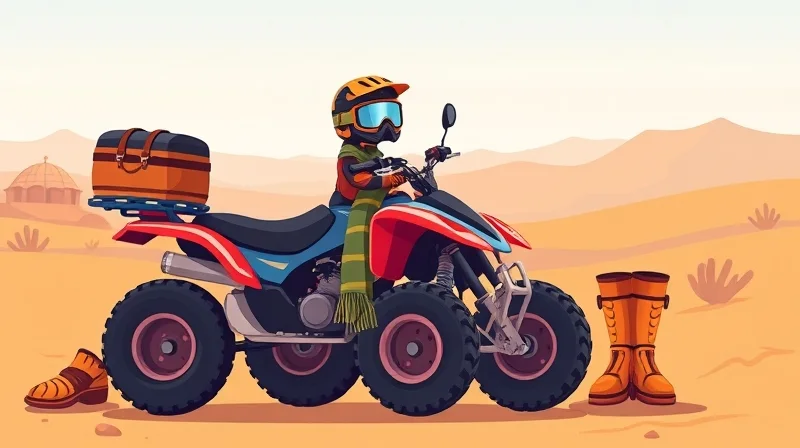
For a quad tour near Marrakech, wear closed shoes, long trousers, a breathable long-sleeve top, sunglasses or dust goggles, and a scarf or buff you can pull over your nose and mouth. Light full-finger gloves help too, though many operators provide them. The helmet is supplied by the operator and is required by Moroccan law for both driver and passenger, so you do not bring your own.
The reason is simple: the tracks through the rocky Agafay desert and the Palmeraie palm grove are dusty and fully exposed to the sun. Agafay is a stony, lunar landscape about 30–40 km southwest of Marrakech (not the Sahara), and the Palmeraie sits at the northern edge of the city, roughly 20 minutes away. On both, protection matters far more than looking good. Fine dust, strong sun and engine heat are the three things your clothing needs to handle. Get those right and the ride is comfortable; get them wrong and you spend it squinting, coughing and sunburnt.
What should you wear on a quad tour in Marrakech?
Wear protective, covering clothing you don't mind getting dusty: closed sturdy shoes, long trousers, a light long-sleeve top, eye protection, and a scarf or buff for your face. Add thin gloves if you have them.
Here is the short version, head to toe:
- Head: helmet provided by the operator; a thin buff or balaclava underneath for hygiene and dust.
- Eyes: UV400 wraparound sunglasses for gentle rides, or sealed dust goggles for fast, windy desert sections.
- Face: a scarf, buff or shemagh you can pull up over nose and mouth.
- Body: breathable long sleeves — sun cover in summer, warmth in winter.
- Legs: long trousers, not shorts.
- Hands: light full-finger gloves.
- Feet: closed trainers or hiking shoes, never sandals.
Everything should be snug rather than loose. Nothing that flaps, dangles or hangs near the wheels or handlebars. Think of it as dressing for wind, dust and sun at the same time, because that is exactly what you get on the trail.
Why does dust matter so much on a Marrakech quad ride?
Dust matters because both the Palmeraie tracks and the Agafay desert throw up a fine, powdery cloud, and it gets much worse when you ride in a group. Riders behind the leader move through a constant haze kicked up by the quads ahead.
That fine dust finds your eyes, mouth and lungs. The fix is two layers of protection working together. First, cover your nose and mouth with a scarf, buff or shemagh so you are not breathing grit for an hour. Second, use wraparound eyewear so dust cannot sneak in from the sides. A buff is the most versatile option because you can wear it loose around the neck and pull it up only when you hit a dusty stretch or the person in front speeds up.
Contact lens wearers should take extra care. Dust trapped under a lens is genuinely painful and can scratch the eye. If you wear contacts, prefer prescription glasses or sealed goggles worn over them, and carry a small bottle of drops. On a windy day in Agafay, sealed goggles are the difference between an easy ride and one spent blinking dust out of one eye.
Is a helmet provided, or should you bring your own?
Reputable operators provide a helmet at no extra cost, and wearing it is standard practice, not optional. Moroccan law requires a helmet for both the driver and the passenger, so you will be given one before you ride. You do not need to bring your own.
Check the fit before you set off. A good helmet is snug without pinching: it should not rock forward or slide side to side when you shake your head, and the chin strap must be fastened firmly enough that you can fit only a finger or two underneath. If the one you are handed is loose or the strap is broken, ask for another. This is a normal request and a good operator will swap it.
Goggles or glasses are worn either under the visor or in place of it, depending on the helmet style. Put your eyewear on first, then the helmet, and adjust the strap over it.
One practical hygiene tip: helmets are shared between customers. A thin balaclava, buff or even a disposable liner worn underneath keeps the padding off your skin and hair. It weighs nothing and doubles as your dust scarf.
Do you need goggles or are sunglasses enough?
It depends on the ride. Wraparound sunglasses are fine for slower, shorter rides such as a gentle loop through the Palmeraie. Sealed dust goggles are the better choice for the faster, dustier desert sections in Agafay and for windy days, because they form a barrier around the eye that glasses cannot.
Whatever you choose, get two things right. First, the lenses should be UV400-rated. The Moroccan sun is strong, and glare off pale rock and dust is tiring on the eyes over an hour or two. Second, use a retention strap. Quads vibrate and you ride into headwind, so unsecured glasses can bounce or blow off — and stopping to hunt for them in the dust is nobody's idea of fun.
If you already own sport sunglasses with a strap, they will usually do. If you are buying something for the trip, inexpensive motocross-style goggles are versatile: they seal well, come with UV lenses, and fit over most prescription glasses. For a comparison of the calmer palm-grove route versus the open desert, see our guide to Agafay vs Palmeraie quad tours.
What should you wear on your feet and hands?
On your feet, wear closed, sturdy shoes — trainers or hiking shoes — never sandals or flip-flops. Quads have metal footpegs and a hot exhaust close to your feet, and open footwear leaves you exposed to both, plus every stone the wheels flick up. Sandals also offer no grip if you need to steady the machine.
On your hands, light full-finger gloves make a real difference. They cut the constant handlebar vibration that tires your hands over an hour, improve grip when your palms get sweaty or dusty, and protect the back of your hands from sunburn — an easy spot to forget with sunscreen. Many operators provide gloves, but check in advance, and a cheap pair of cycling or work gloves is fine if they don't.
Avoid anything loose around your hands and wrists. Dangling scarves, long drawstrings, wide bracelets or a bag strap left swinging can catch on the controls or moving parts. Keep straps tucked and clothing close-fitting.
How should you dress for each season in Marrakech?
Dress for the season, because Marrakech swings from cold desert mornings in winter to fierce heat in summer. Below are typical ranges to plan around; always check the forecast for your exact date.
- Spring (March–May) and autumn (September–November): the best seasons for riding, with typical daytime highs around 20–30°C. Mornings and evenings are cooler, so layer a light jacket or fleece you can take off. Comfortable all round.
- Summer (June–August): hot. Average July highs sit around 37–38°C, and Marrakech has recorded extremes up to 49.6°C. Wear breathable, light-coloured long sleeves — counter-intuitively, covering up protects you from sunburn better than bare skin. Because of the heat, summer tours run early morning or at golden hour/sunset rather than midday. Carry plenty of water.
- Winter (December–February): days are mild but mornings can drop toward 6–8°C, and the open desert feels colder still once you add wind chill from riding. Wear warm layers and a windproof jacket, especially for early-morning or sunset rides in Agafay, where the temperature falls fast after the sun goes down. Gloves are genuinely welcome here.
If you are weighing an early ride against an evening one, our sunset vs morning Agafay comparison walks through the light, temperature and dust trade-offs.
What should you avoid wearing on a quad tour?
Avoid anything that leaves skin exposed, flaps loose, or traps heat. Each mistake below has a practical downside on the trail:
- Open sandals or flip-flops: no protection from the hot exhaust, footpegs or flying stones, and poor grip. Closed shoes only.
- Shorts: your legs are exposed to dust, sunburn and the occasional thorny branch on the Palmeraie tracks. Long trousers are cooler in the sun than you'd expect.
- Loose scarves or long drawstrings: anything that can whip into the wheels or catch on the controls is a real hazard. Keep it tucked or wrapped snug.
- Expensive jewellery and watches: dust gets into everything, and rings or bracelets can snag. Leave valuables at the hotel.
- Dark, heavy clothing in summer: it absorbs heat and makes a 38°C ride harder than it needs to be. Choose light colours and breathable fabric.
In short, dress for function. The trail rewards covered, close-fitting, breathable clothing and punishes anything chosen for looks.
What else should you pack for the ride?
Beyond clothing, pack a small kit for sun and hydration. Most tours already include the quad, fuel, guide and helmet, so you are only bringing personal protection and sun gear.
- SPF 50 sunscreen — apply before you set off and reach the back of the neck, ears and hands.
- Refillable water — the dry heat dehydrates you faster than you notice, especially in summer.
- Lip balm with SPF — wind and dust chap lips quickly.
- A small backpack that sits flat on your back, with straps you can cinch tight so nothing swings.
- A phone strap or a zipped pocket — a phone in an open pocket bounces out on rough ground.
A typical ride is 1–2 hours on the quad (about 2.5–3 hours in total with transfers), and hotel or riad pickup is usually included. Keep the kit minimal: you want your hands free and nothing loose. If you're deciding which tour format suits you, compare the options on our best quad tour in Marrakech page, or browse the Agafay desert tours directly.
Frequently asked questions
Do I need a licence for a quad in Marrakech?
No. Tourist quad tours run on private tracks, so no driving licence is required. Operators typically set a minimum driving age of 16 (16–17 accompanied by an adult), while younger children ride as passengers on two-seater quads. Helmets are legally required for both driver and passenger.
Can I wear my prescription glasses under the helmet?
Yes. Most helmets accommodate glasses, and you can wear wraparound prescription sunglasses or fit motocross-style goggles over regular glasses. If you wear contact lenses, prefer glasses or sealed goggles, since trapped dust under a lens is painful.
Is it too hot to ride in summer?
It can be very hot — average July highs are around 37–38°C — which is why summer tours are scheduled for early morning or golden hour/sunset rather than midday. Wear breathable long sleeves, use SPF 50 and carry plenty of water and it's manageable.
What do children wear on a quad tour?
Children riding as passengers wear the same protection as adults: a provided helmet, closed shoes, long trousers, a light long-sleeve top and a scarf or buff for dust. Bring a child-size hat and sunscreen, and confirm the helmet fits snugly before the ride.
Do tours provide clothing or just the helmet?
Operators provide the helmet, usually goggles, and often gloves, but not general clothing. You bring your own shoes, trousers, long-sleeve top and face scarf. Insurance coverage varies between operators, so always check what is included when you book.
Still deciding between the desert and the palm grove, or a quad-only ride versus quad plus camel? Our comparison hub breaks down the routes so you can pick before you pack.
Sources
- Morocco National Tourist Office — official travel information
- Marrakesh climate normals and monthly averages — Wikipedia (cited station data)
- World Meteorological Organization — World Weather Information Service
- Climate-Data.org — Marrakech temperature and climate data
- World Health Organization — sun protection and UV radiation guidance