Palmeraie or Jbilet: which half-day quad track fits your ride?
Pick the Palmeraie if you are a first-timer, riding with family, or want a gentle, shaded circuit; pick the Jbilet hills if you are a confident rider who wants open space, speed and a stronger desert feel. Both run as roughly two-hour half-day tours from Marrakech, so the choice is about terrain and temperament, not logistics.
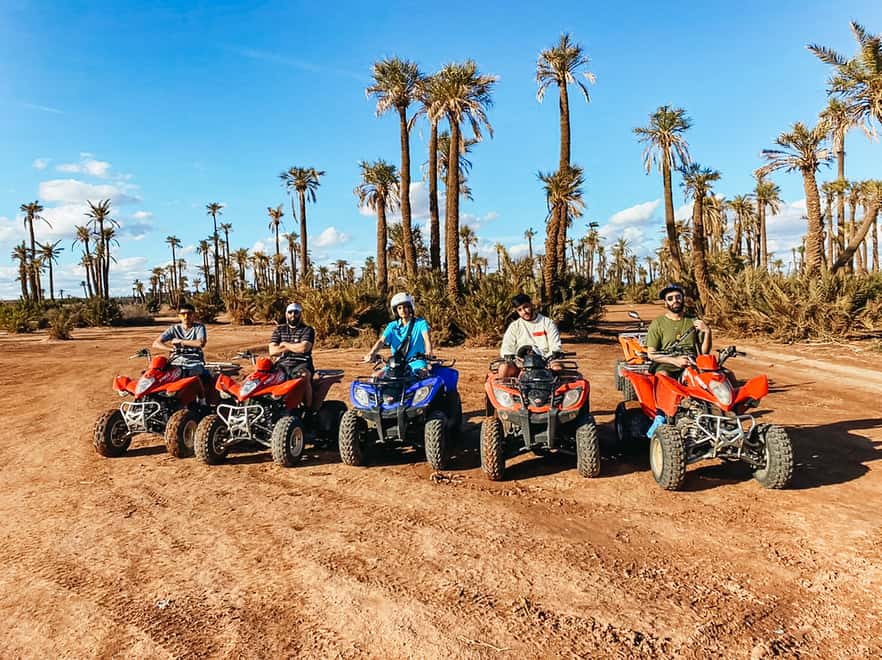
The Palmeraie is the palm grove on the northern edge of Marrakech. Its tracks are flat and enclosed, winding between palms and olive trees on compact dirt lanes. There are few surprises, the natural pace is slow, and the shade takes the edge off the heat. That combination makes it the easier, calmer option.
The Jbilet (also spelled Jbilat) hills sit in the desert north of the city. The ground is open, stony and rolling — a bare, rocky landscape with occasional sandy stretches. There is room to accelerate and longer sightlines, but also more vibration, more uneven ground, and more physical effort. It rewards experience and can feel repetitive to a rider who only wants an easy loop.
The rest of this guide breaks down the trade-offs — location, terrain, who each track suits, timing, kit and cost — so you can book the half-day tour that matches your confidence level.
Where are the Palmeraie and the Jbilet hills, and how far from central Marrakech?
Both tracks are close enough to central Marrakech for a morning or afternoon slot with no overnight stay. The Palmeraie sits at the northern edge of the city, with a transfer of about 20 minutes from most riads and hotels. The Jbilet hills lie a little further out in the desert to the north, but the drive is still short.
This is the practical advantage of both options over the rockier Agafay desert, which is further southwest and takes longer to reach. You can slot a Palmeraie or Jbilet ride into half a day and still have time for the medina, a hammam or lunch.
Hotel or riad pickup is included on most tours, so you rarely need your own transport. A driver collects you, you ride for one to two hours, and you are dropped back — the whole outing typically takes around two and a half to three hours door to door. If you are still weighing where to be based for easy pickups, see our notes on getting there and transport around Marrakech.
What is the terrain like in the Palmeraie compared with the Jbilet desert?
The Palmeraie is flat and forgiving; the Jbilet is open, stony and faster — and terrain difficulty maps almost directly onto how confident you feel on a quad.
In the Palmeraie you ride compact dirt tracks that thread between palm groves, olive trees and small farm lanes. The ground is level and predictable, the corners are gentle, and the palms naturally keep your speed down. It is easy to control, which is exactly why nervous riders relax here.
The Jbilet is a different environment: an open, bare landscape of rocky flats and low foothills, sometimes described as 'lunar' because of the stone-strewn ground. There are sandy sections in places, wider lines to follow, and far fewer obstacles boxing you in. That openness lets you go faster — but the reward comes with more vibration through the bars, more jolts from uneven rock, and more concentration to read the ground ahead.
A simple rule: the more open and rocky the terrain, the more it asks of the rider. The Palmeraie asks very little. The Jbilet asks more, and gives more back if you are ready for it. For a sense of how a stonier desert compares overall, our Agafay vs Palmeraie quad comparison covers the same flat-versus-rocky trade-off.
Which track suits a first-time or nervous rider?
The Palmeraie is the clear choice for first-timers, cautious riders and anyone attempting a shorter ride. Its flat, enclosed lanes and slow natural pace mean you are never forced beyond your comfort zone, and the shade keeps you cooler while you find your feet.
Every reputable tour begins with a short safety briefing: how the throttle and brakes work, how to corner, and how to stay in single file behind a guide. Most tourist quads are automatic (twist-and-go), so there are no gears to manage — you accelerate, you brake, and that is most of it. No driving licence is required for these tours because they run on private tracks rather than public roads.
For an anxious rider, the Palmeraie's shade matters more than it sounds. Heat stress raises your heart rate and shortens your patience; riding under palms instead of open sun keeps you calmer and more in control. If you are unsure whether quad biking is for you at all, the Palmeraie is the lowest-pressure way to find out. A gentle option like the Palmeraie quad tour with a tea break builds in a rest, which suits first-timers well.
Which track suits a confident rider who wants speed and open space?
The Jbilet hills reward experience with room to open the throttle and varied ground that stays interesting. If you have ridden before and found flat palm-grove loops too tame, this is the track that will hold your attention.
The long sightlines across the open desert let you accelerate on the straighter stretches, and the mix of rocky flats, low rises and sandy patches keeps changing under your wheels. It feels much more like a desert adventure than a garden circuit, and it is far less monotonous for return riders who already know the basics.
Be honest with yourself about the cost, though: the vibration and uneven terrain take real physical effort. Your arms, shoulders and core work harder over a couple of hours than they would on the Palmeraie's smooth lanes, and the dust is heavier in the open. That is the trade for the extra freedom — and for experienced riders it is usually a trade worth making.
Is either track suitable for families with children?
Families can ride both tracks, but the Palmeraie's gentler terrain is generally the safer family choice. Younger children who are too small to drive typically ride as passengers on a double quad with an adult driver, and some operators also offer buggy or side-by-side vehicles that seat a child more securely.
Moroccan law requires helmets for the driver and the passenger, so everyone rides protected. The typical minimum driving age with operators is 16, and riders aged 16 to 17 are usually accompanied by an adult; below that, kids join as passengers rather than driving their own machine.
Minimum-age and child-passenger rules vary from one operator to the next, so do not assume a single fixed cut-off — check the specific tour page before you book so you know exactly how your children can take part. For families, the flat, enclosed Palmeraie lanes are easier to supervise and less demanding than the open Jbilet flats.
How long is a half-day quad tour and what does a typical itinerary include?
Most half-day quad tours give you one to two hours of actual riding, with the whole outing running about two and a half to three hours once transfers are included. Some longer versions exist, but the standard half-day format is built around that ride window.
It helps to separate two things in your head:
- Ride time — the time you spend on the quad, usually one to two hours.
- Tour time — the full door-to-door outing, including hotel pickup, the drive out, the briefing, the ride, any break, and the drive back.
Many Palmeraie routes include a stop at a Berber house for a mint-tea break, which is a rest as much as a cultural pause. Jbilet routes tend to focus more squarely on the riding itself. When you read a listing, look for whether the headline number refers to ride time or total time — that single distinction is what stops the day from running longer than you planned.
When is the best time of day and season to ride each track?
Ride early in the morning or around golden hour in summer, and favour spring or autumn overall. Marrakech summers are hot — average July highs sit around 37 to 38 °C, and the city has recorded extremes as high as 49.6 °C — so midday rides in July and August are uncomfortable and, on the exposed desert, genuinely draining.
In the hot months, operators lean toward early-morning or late-afternoon and sunset slots for good reason. This is where the two tracks diverge again: the Palmeraie's shade makes it more bearable when the sun is high, while the open, treeless Jbilet flats are only really comfortable in the cooler part of the day or the cooler part of the year.
Spring and autumn are the mildest overall, with daytime temperatures often in the 20 to 30 °C range — the most comfortable window for either track, and especially for the exposed Jbilet ride. If you are choosing a summer slot, our comparison of sunset versus morning rides explains how the light and heat differ between the two.
What should you wear and bring for either half-day tour?
Wear closed shoes and clothes you do not mind getting dusty, and bring sun protection and something to cover your face against dust. Quad tracks are dusty by nature, and the open Jbilet desert throws up noticeably more than the sheltered Palmeraie.
A simple checklist for both tracks:
- Closed shoes — trainers or boots, never sandals.
- Sunglasses and sunscreen — the sun is strong even outside summer.
- A scarf or buff — to keep dust off your mouth and nose, more important on the open Jbilet.
- Clothes you can get dirty — dust settles into everything.
- A light layer — early-morning and sunset rides can be cool before the sun climbs.
Operators provide the helmet, and usually goggles and gloves as well, so you do not need to bring your own. Goggles are especially welcome on the dustier desert track. It is always worth confirming what is included when you book.
How much do Palmeraie and Jbilet quad tours cost, and how do you compare them?
Half-day quad tours are priced per person, and the figure depends on duration, whether the tour is private or shared, and whether pickup is included — so check the live prices on each tour page rather than any fixed number here. Because availability and rates change, this site shows current prices, availability and verified ratings through the GetYourGuide widgets on each tour page.
Rather than fixate on the headline price alone, compare tours on the things that actually change your day:
- Duration — how much ride time, not just total tour time.
- Group size — private tours cost more but move at your pace; shared tours are cheaper but larger.
- Insurance — coverage varies between operators, so confirm what is and is not included.
- Pickup — check that hotel or riad transfer is part of the price.
Run the same checklist across any tours you are weighing and the right value usually becomes obvious. Our roundup of the best quad tours in Marrakech applies exactly these criteria across the main options.
A quick decision guide: choosing your half-day track in one minute
Palmeraie for calm and comfort, Jbilet for space and speed, or a combined tour if you cannot decide.
- Choose the Palmeraie if: you are a first-timer or nervous rider, you are riding with family or young children, you want shade in the heat, and you prefer easy, predictable terrain.
- Choose the Jbilet if: you are a confident rider, you want open sightlines and room to accelerate, and you want a stronger desert-adventure feel with more varied ground.
- Choose a combined tour if: you want a bit of both — several operators run routes that link the Palmeraie and Jbilet in one half-day outing, like the Palmeraie and Jbilat quad adventure.
If you are still torn, the combined route is the safest bet: you sample the easy palm-grove lanes and the open desert flats in a single trip and see which one you actually prefer.
Frequently asked questions
Do you need a driving licence for a quad tour in Marrakech?
No. Tourist quad tours run on private tracks rather than public roads, so no driving licence is required. You will still get a short safety briefing before you ride.
Is quad biking in Marrakech safe for beginners?
Yes, particularly on the Palmeraie track. The quads are usually automatic, the pace is slow, guides ride with you, and helmets are mandatory for both driver and passenger under Moroccan law. Follow the briefing and stay within your comfort zone.
Can you combine the Palmeraie and Jbilet in one tour?
Yes. Several operators offer half-day routes that link the shaded Palmeraie lanes with the open Jbilet desert, which is a good way to experience both types of terrain in a single ride.
How far in advance should you book?
Booking ahead is wise in high season and for popular sunset slots, since these fill up first. Check current availability directly on the tour page, where the live widget shows open dates and times.
Is hotel pickup included, and are the quads automatic?
Hotel or riad pickup is included on most tours, and the majority of tourist quads are automatic (twist-and-go), with no gears to manage. Confirm both details on the specific tour page before booking, along with what the insurance covers.
Still deciding between the flat palm grove and the open desert? Compare your options side by side on our quad tour comparison hub and book the track that matches your confidence.
Sources
- Moroccan National Tourist Office — Visit Morocco — official destination information for Marrakech and the surrounding region.
- Direction Générale de la Météorologie du Maroc (MarocMétéo) — official Moroccan weather and climate service.
- Marrakesh — climate overview, Wikipedia — summary of the city's climate, including summer temperature ranges and recorded extremes.
- Transport in Morocco — Wikipedia — background on Moroccan traffic and helmet regulations.